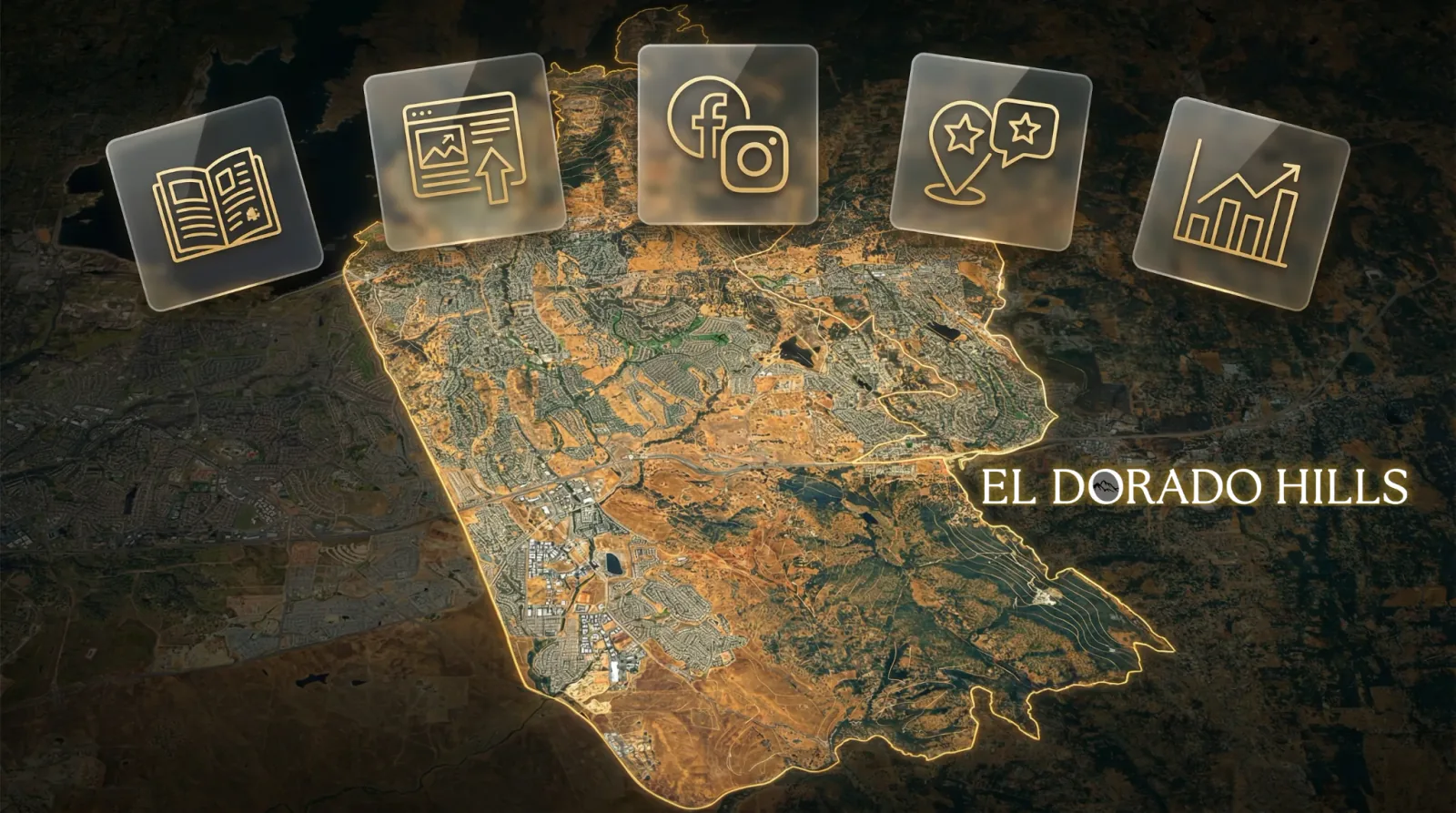
Reach

Getting found is a different job than being ready when they find you.

The website is the second job. It has to hold up when somebody finally looks. Reach is the first one: putting you in front of people who were never going to search for you, in the communities you want to be working in.

Nothing on this page carries a published price, and that's deliberate. The websites are priced in public because a build is a defined scope. This isn't. Reach is built to your budget, your goals, and what you're already running, so you'll get a real number on a call instead of a starting-at number I'd have to revise later.

The peak isn't louder than the valley. It's just standing where the light lands first.

Position, not volume

The two lanes

Lane 01

Build

Custom websites, hand-coded and handed over. Four tiers, one standard of work, and I fulfill every one of them myself.

Public pricing. Four build tiers and two recurring plans, all with the number printed on the page.

See the tiers and prices

Lane 02

Reach

Getting the business in front of the right people. Part of it I run in house. Part of it is placed through a media platform that buys access at a scale I could never reach alone.

Consultative. Built to your budget, your goals, and what you're already running.

Start with the Meta program

In House

Advanced Meta lead nurture.

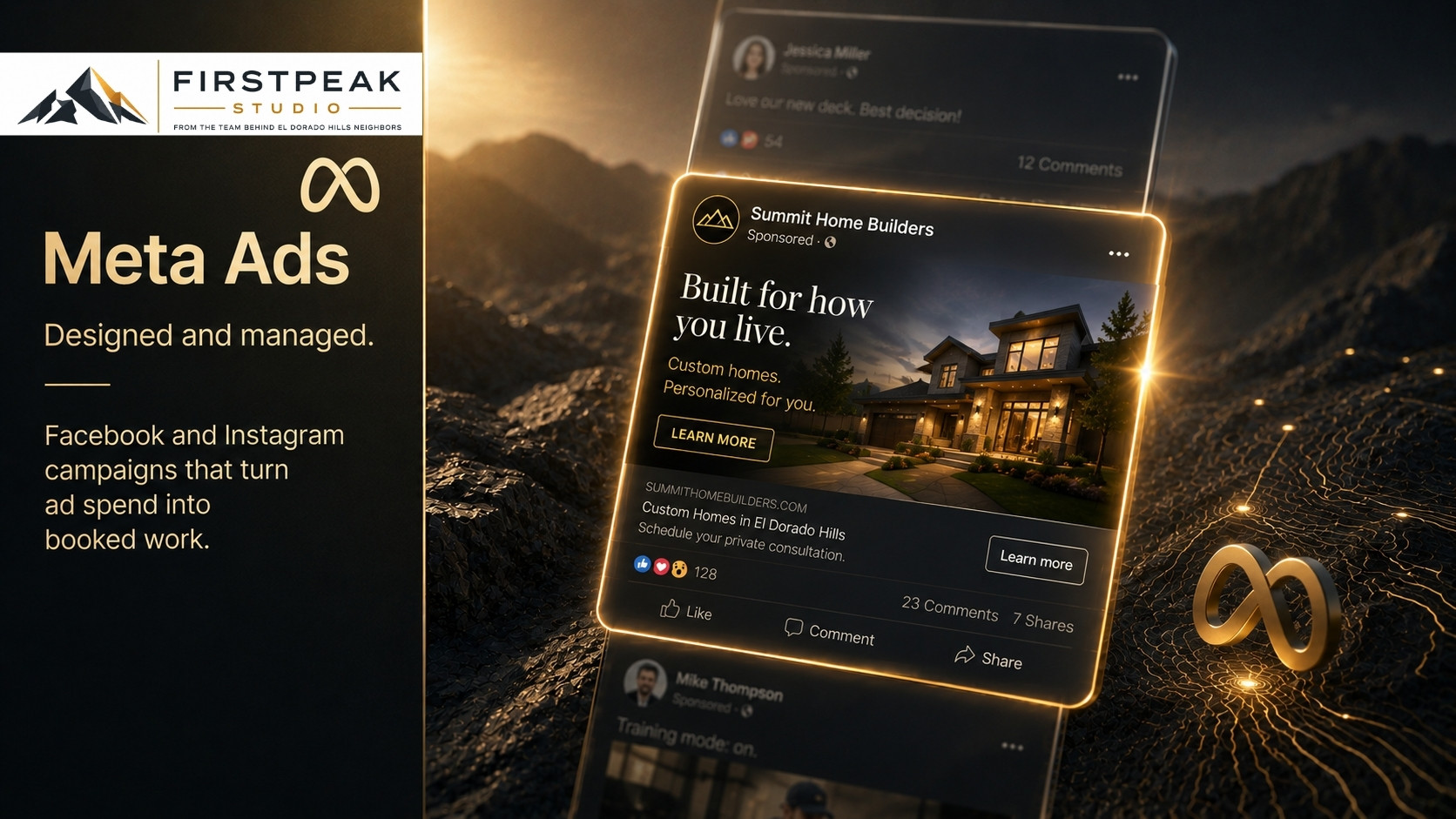
This is the flagship on the reach side, and the part I run myself. Most of what gets sold as Facebook advertising is a boosted post pointed at a lead form nobody answers. This is the other thing, and here is what makes it different, named concretely enough that you can check every line.

A sponsored Meta feed ad glowing in a social feed over a gold mountain landscape
  • Advantage+ Leads campaigns. Meta's current lead structure, not a legacy setup left running because somebody built it in 2021 and nobody touched it since.
  • The Conversion Leads goal, fed by the Conversions API. Server-side events plus offline closed-won uploads, so the system optimizes toward people who actually became customers, not toward people who were willing to type their name in a box.
  • Value optimization against real lead values. A full replacement and a service call are not the same lead. Once the system knows what each one is worth to you, the budget goes where the work is worth having.
  • Current lead form verification gates. The verification steps Meta now offers on instant forms, switched on, so the junk gets filtered before it ever reaches your phone.
  • Three to six role-differentiated creatives. Each one doing a different job: the objection, the proof, the offer, the reminder. Not fifty near-identical variants burning budget to learn nothing.
  • Real-time CRM sync with monitored token health. Leads land in the CRM the second they're submitted, and the connection gets watched. A quietly expired token is the single most common way a working program stops working without anyone noticing.

Folded in, not a line item

The AI chat assistant

Nurture without an instant reply is not nurture. The assistant answers the moment a lead comes in, at nine at night and on a Sunday, asks the qualifying questions, and either books the appointment or hands the person to you warm.

It's part of the program because the program does not work without it. It answers on the site and in the ad follow-up, in the same voice, with the same information.

Also folded in

Review request automation

Every closed job triggers a request at the right moment, and the responses get monitored so nothing sits unanswered for a week.

Reviews are the cheapest asset a local business owns and the one most often left to chance. This runs quietly inside the same system that handles the leads, so it isn't one more thing to remember.

The honest boundary

Text messaging requires carrier registration before a single message can send, and that approval takes two to four weeks. It is not a delay I can shorten by asking nicely. We start the paperwork on day one, and email plus the chat assistant carry the follow-up until it clears.

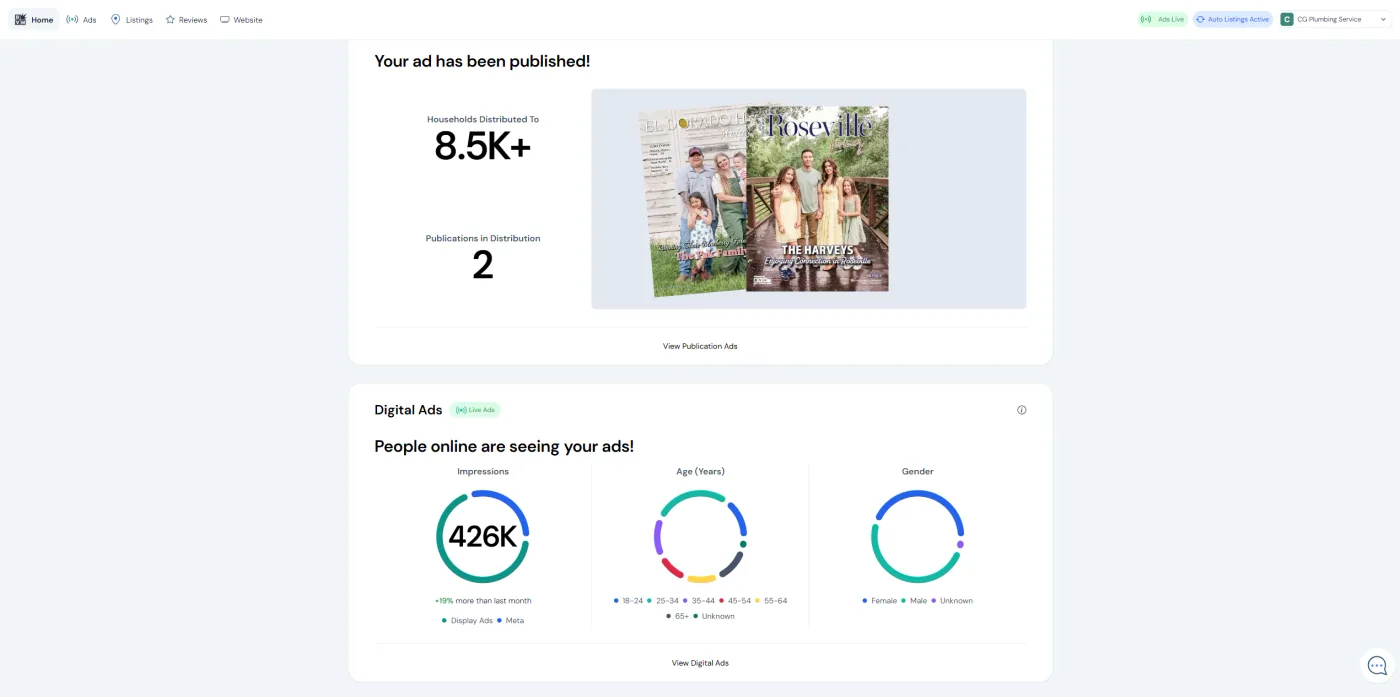
A live campaign reporting dashboard shown in plain numbers

Signal is the reporting layer that sits on top of all of it. A plain-English command center where you see what the money did, in dollars and customers, instead of in impressions and reach percentages.

See the command room

The Add-Ons

Four add-ons. Only four.

Each one earns its place or it wouldn't be on the page. For each: what it is, who it's right for, and where the line is. The line is the part most people skip.

Add-on 01
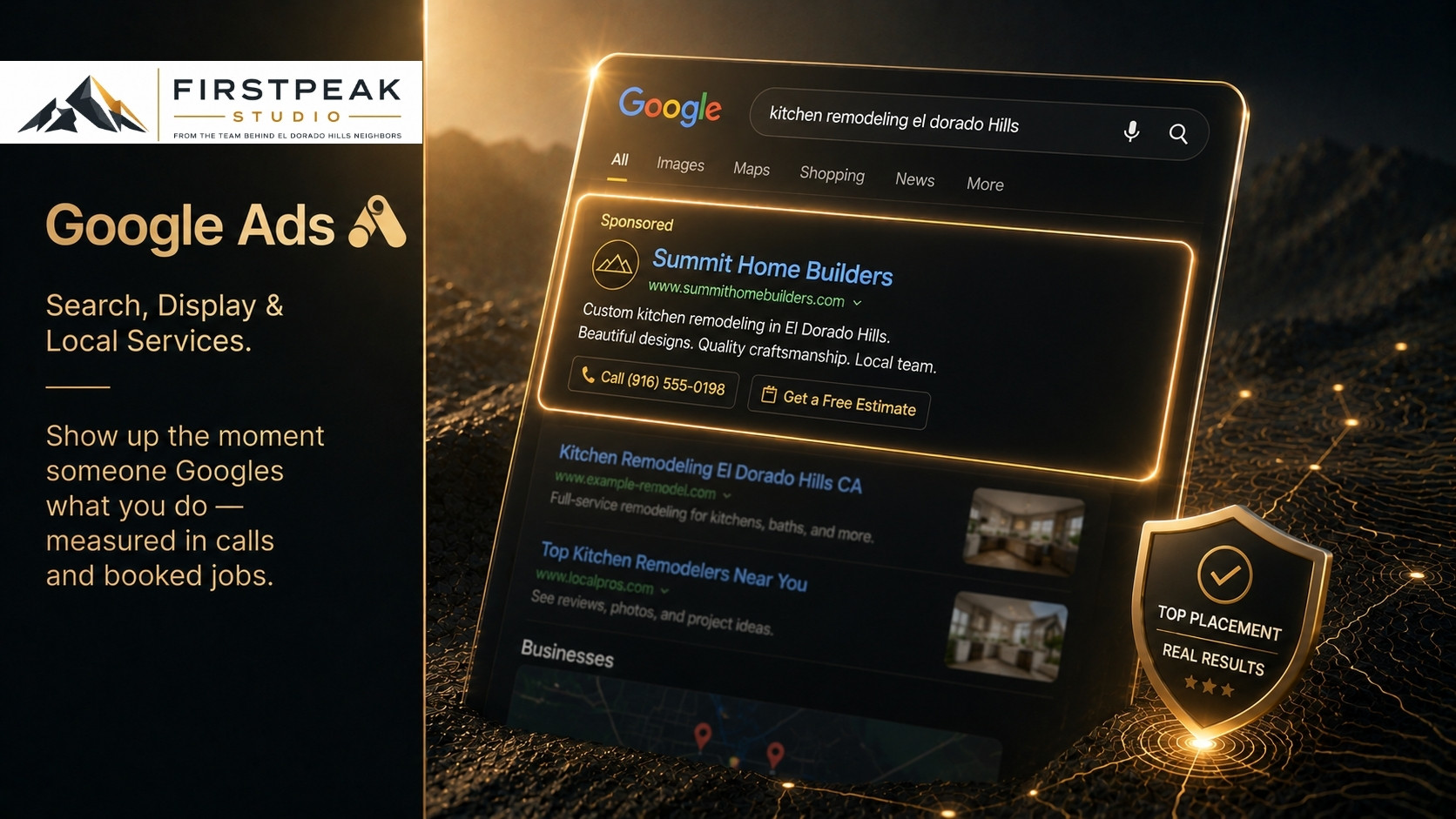
A pay-per-lead placement at the top of local search results, over a gold mountain landscape

Google Local Services Ads

Pay-per-lead placement at the very top of local results, above the regular ads. You pay when someone contacts you, not when someone clicks. Setup includes the license and insurance verification that earns the Google Verified badge on your listing.

Right forHome services, professional services, and health and wellness. It's built for the categories Google supports, and it rewards the businesses that actually answer the phone.

Where the line isI run the pay-per-lead product. I don't run keyword campaigns where you pay for clicks. And a verified, complete Google Business Profile is a hard prerequisite, so if yours isn't there yet, that is step one and it happens first.

Add-on 02
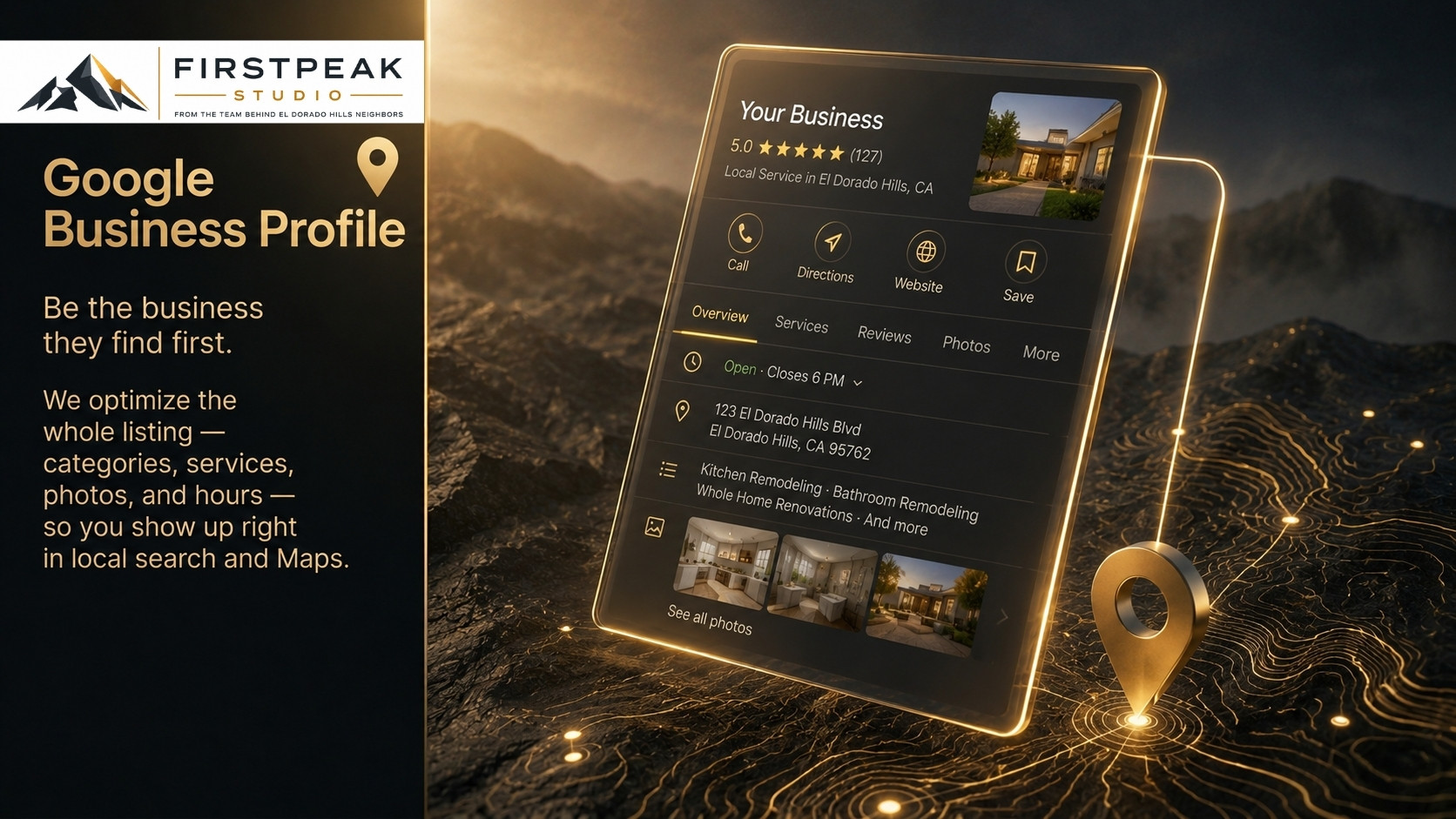
An optimized Google Business Profile listing glowing over a gold topographic mountain landscape

Google Business Profile optimization

Primary and secondary category research, a keyword-aware description, a complete services list, products, categorized photos, hours hygiene, and Q and A seeding. Then the profile gets pointed at the inner service page that answers the search, instead of dumping everyone on the homepage.

Right forAny local business with a profile that was claimed once, years ago, and never touched again. It's also the groundwork that makes Local Services Ads possible in the first place.

Where the line isThis is profile work, not ranking work. It makes the profile complete, accurate, and useful to a person deciding whether to call. Nobody controls the map pack, and I'm not going to tell you I do.

Add-on 03
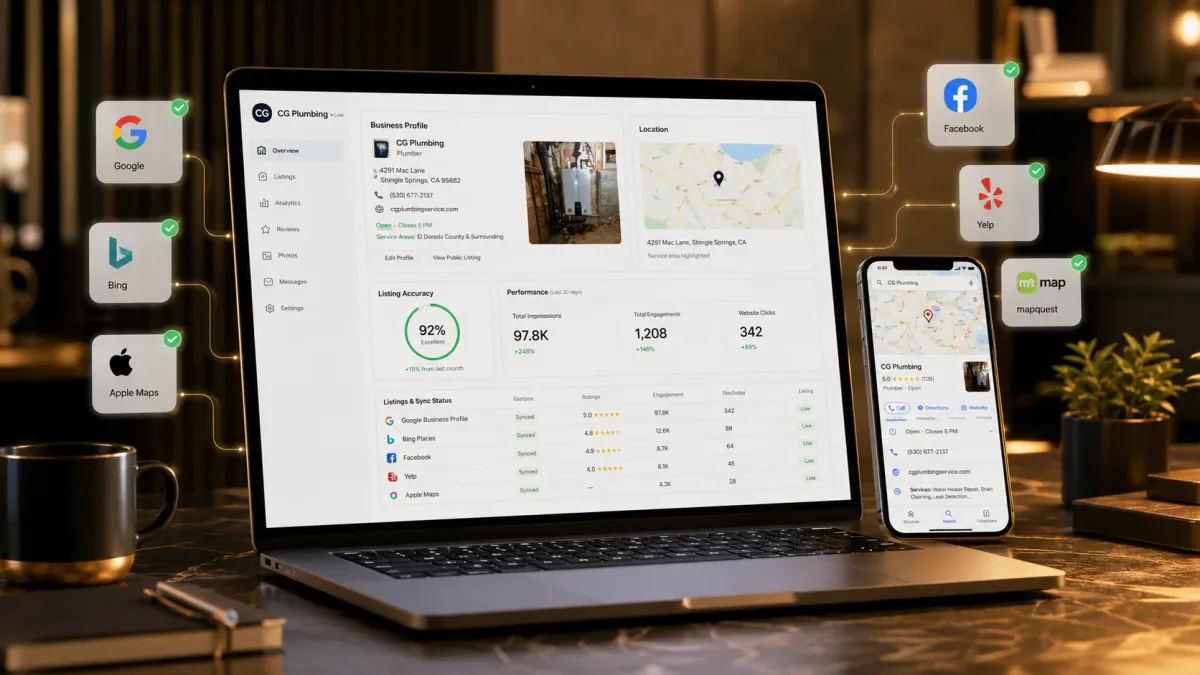
A business listing shown consistent and correct across the directories that feed search

Online Listings

An owned listing build and cleanup. Your name, address, phone, hours, and category built out correctly across the directories and data sources that feed search and AI assistants, then cleaned of duplicates and of the wrong phone number left over from two moves ago.

Right forBusinesses that have moved, rebranded, changed numbers, or simply been around long enough to leave a trail of stale records. Also anyone who wants an AI assistant to answer correctly when somebody asks about them.

Where the line isListings you keep, not listings you rent. When the engagement ends, the corrected records stay yours. And the pitch here is being verifiable, not ranking higher on a map.

Add-on 04
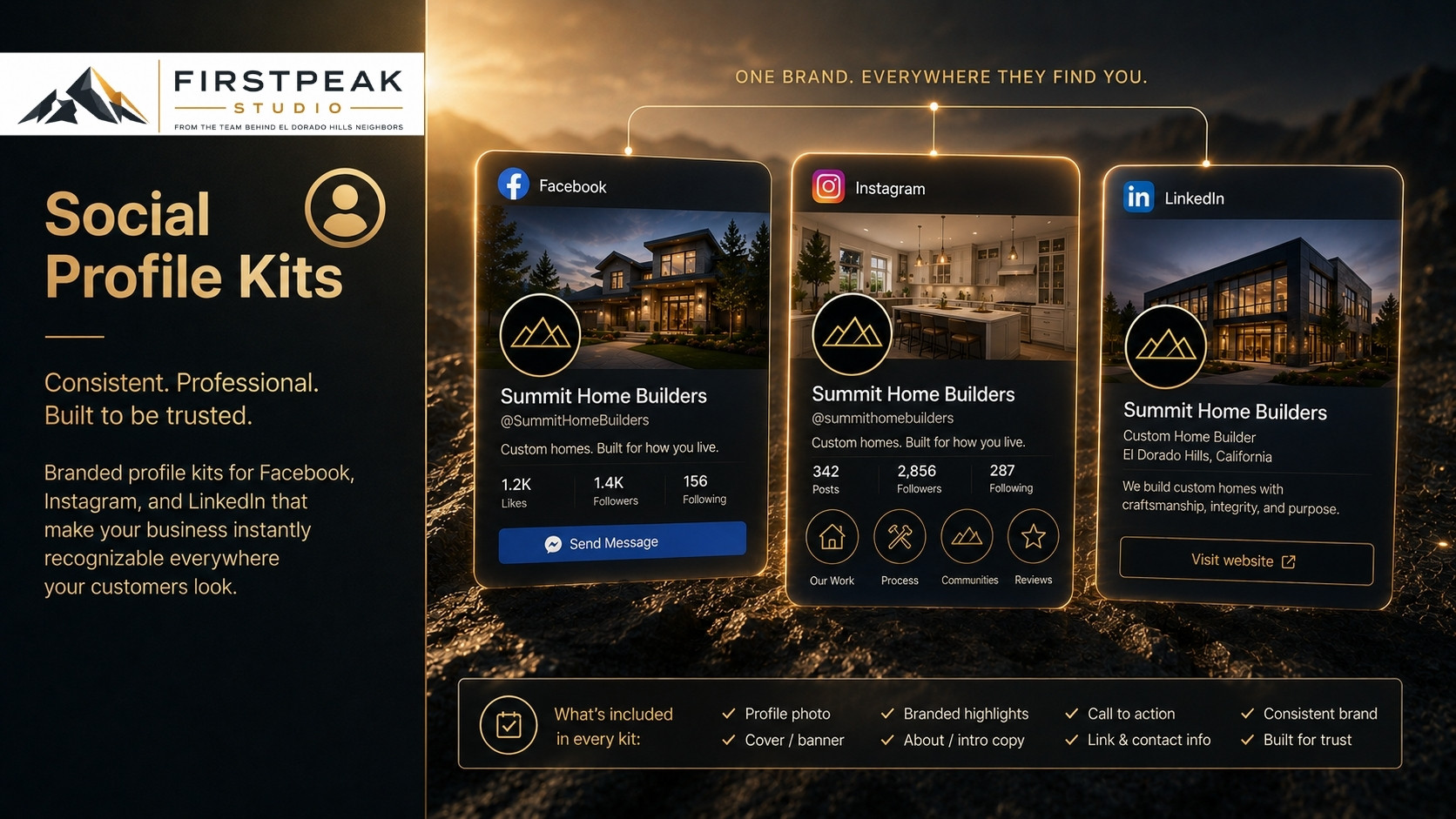
Consistent Facebook, Instagram, and LinkedIn business profiles for one brand, over a gold mountain landscape

Business Socials Kits

A one-time build. Three or four platforms set up properly, or a single-platform refresh. Profile and cover art, bio, category, links, contact paths, and pinned content, consistent across every one of them.

Right forBusinesses whose profiles were made in a hurry years ago and now contradict each other, and new businesses that want to look established on day one.

Where the line isThis is a consistency and first-impression asset. It is not a lead generator and I won't sell it as one. When somebody looks you up before calling, this is what they find.
What I Place

The other half isn't something I run. It's something I buy you access to.

There's a hard limit to what one person with an ad account can reach. Past that limit the answer isn't working harder. It's buying access to systems that were already built, already bought at scale, and already landing in the communities you want to be working in.

I publish El Dorado Hills Neighbors myself. Through the network I partner with, as Market Leader for the Greater Sacramento region, I can place clients into publications and the digital systems around them across all of Northern California. That's 25,000+ affluent homeowner households reached monthly across Greater Sacramento, and over 100,000 across Northern California, selected on home ownership and home value rather than sprayed across a ZIP code. Here is the actual menu, so the word custom never has to stand on its own.

  • Publication placement

    A page in a private community publication that arrives in a mailbox and stays on a counter. Guaranteed distribution, named communities, known drop dates.

  • Sister publications across Northern California

    Roseville Living, Fair Oaks Living, Gold River Living, Rancho Murieta Neighbors, Southport Neighbors, and titles well beyond that list. Those are examples of local presence, not the limit of where I can place you.

  • Regional multi-market programs

    One buy across several of the communities you want to be working in, instead of negotiating each one separately and paying single-market rates on all of them.

  • Household-address matched digital

    Digital delivered against the same household addresses the print reaches, so the two arrive as one impression rather than two unrelated ones.

  • Google and Bing display

    Display inventory bought at platform scale and pointed at the communities you want to reach, rather than at whatever a small standalone budget can win on its own.

  • Retargeting

    The people who already visited the site, followed across the web so the second look costs a great deal less than the first one did.

  • Listings at platform scale

    Your business pushed out to the directories and data aggregators that feed both search results and the AI assistants people now ask instead of searching.

  • Reviews management at platform scale

    Requests, monitoring, and response tooling run through the platform, rather than bolted onto one profile at a time.

A geo-targeting map drawing a tight boundary around the communities in a media buy
A tight boundary around the communities in the buy. Not a region-wide spray, and not a guess.

That's the short version. How the publications actually work, what guaranteed distribution means, which titles run where, and what a placement looks like in practice, all of that lives on its own page.

See the publications

The Advantage

Why the same budget buys more here.

This is a mechanism, not a claim. It works the same way whether you like it or not, which is the only kind of advantage worth telling you about.

Ad platforms price on volume. That's the whole thing, and it isn't a secret. The more inventory a buyer commits to, the better the position and the rate that buyer gets. A single local advertiser walks up to that counter alone.

The network I partner with buys at a contract scale no single local advertiser can reach. Nothing about that makes your budget bigger. It changes what your budget is standing next to when it walks up to the counter.

So a budget that would buy you leftover inventory on your own buys premium placement here. And it switches on ad systems that normally carry five-figure minimums before a local business is allowed in the door at all.

I'm not going to publish a percentage saved, a CPM comparison, or an impression multiple, because the honest version of that number depends entirely on what you're buying and when you're buying it. You'll see the real numbers on your own plan, on the call, with your name on them.

That's the platform I place through. I'm the one who works your account.

The Honest Ledger

What I'll prove, and what I won't pretend to know.

Every agency has this list. Most of them only show you the left column. Here's both, because the second one is how you tell whether the first one is worth anything.

What I'll prove

  • Distribution on print: the household count, the named communities, and the drop dates.
  • Delivery on digital: impressions bought against impressions served, reported per placement.
  • Every form fill, call, and chat that arrives through a system I control.
  • Cost per lead on the channels that actually produce leads, alongside the creative and the audience that produced them.
  • What happened to each lead after it landed, once your CRM is connected and closed-won is coming back into the system.

What I won't pretend to know

  • Which page somebody was looking at when they decided to call you.
  • A cost per lead for print. Print has no performance metrics, and that is fine.
  • Clean attribution for a call that came in because your name showed up in three places over two months.
  • An ROI figure for presence, in the same month the presence ran.
  • What a competitor pays, or what a competitor is getting for it.

The measurement protocol

Here is how we make the read honest. Before the first placement runs, we take four to eight weeks of baseline on branded search, direct traffic, and inbound calls, so there is a real before to compare against. We add a 'how did you hear about us' question at intake, because the imperfect answer a customer gives is still better data than a guess. Then we wait properly. A monthly book carries a four to eight week lag by its nature, and it takes three to six months before the read means anything at all. If you need a verdict faster than that, say so on the call and I'll point you at the channels that can give you one.

How I Decide

Three questions turn "it depends" into a plan.

There's no published price on this page, so here's the method instead. Same three questions, every time, in this order.

Question 01

What's your budget?

Not to find your ceiling. To find out which instruments are even worth putting on the table. Spreading a small budget across six channels is how you get six results too small to read. I'd rather run two things properly than six things badly.

Question 02

What does a good month actually look like for you?

Not a revenue target. A number of jobs, or calls, or booked appointments, and what one of them is worth to you. That number decides everything downstream, including whether I should be selling you anything at all right now.

Question 03

What are you already running?

Whatever is working stays. I have never once found a business running nothing. The job is usually to stop paying for the parts that quietly stopped working, and to move that money to where it lands.

Those three answers turn it depends into a plan with named instruments, a stated budget split, and a date we look at it again. You'll have it in writing before you spend a dollar, and if the honest answer is that you shouldn't spend anything yet, that's the answer you'll get.

Common Questions

Reach questions, answered.

Why isn't there a price on this page?

Because a real number needs three things I don't have yet: your budget, what a good month actually looks like for you, and what you're already running. Websites are priced in public because a build is a defined scope. This isn't. I'd rather give you a number I can stand behind than a starting-at number I'd have to revise on the call.

Do I have to buy a website first?

No. Plenty of clients start on the reach side and never touch their site. That said, if the site loses people once they land on it, more traffic just means more people leaving, and I'll tell you that before I take the money.

How fast can Meta lead nurture start producing?

Campaigns can be live in about a week once the ad account, the pixel, the Conversions API, and the CRM connection are sorted. Text messaging is the slow part: carrier registration takes two to four weeks before the first text can send, so email and the chat assistant carry the follow-up until it clears.

What does the publication network actually get me?

Access. It is placement into private community publications and the digital systems that ride alongside them, bought at a scale no single local advertiser reaches on their own. I publish El Dorado Hills Neighbors myself, and through the network I partner with I can place clients across Northern California. The publications page has the full picture.

Can you prove print worked?

I can prove it was delivered: the household count, the named communities, and the drop dates. I can't hand you a cost per lead for a printed page, because print has no performance metrics. Anyone who gives you one is guessing. Guaranteed distribution on print, guaranteed impressions on digital, guaranteed outcomes on neither.

How long before I know whether this is working?

Four to eight weeks of baseline before the first placement, then three to six months before the read means anything. A monthly book carries a four to eight week lag by nature. If you need a verdict in thirty days, say so on the call and I'll point you at the channels that can give you one.

Start Here

Let's find where the light lands.

Twenty minutes, three questions, and a straight answer about what's worth running and what isn't. You'll leave the call knowing more than you came in with, whether or not you hire me.

Book 20 Minutes

No pitch deck, no obligation, no pressure. If we're not a fit, I'll say so on the call.